Bring CRM, Sales, Support and Business Operations Together with Zoho
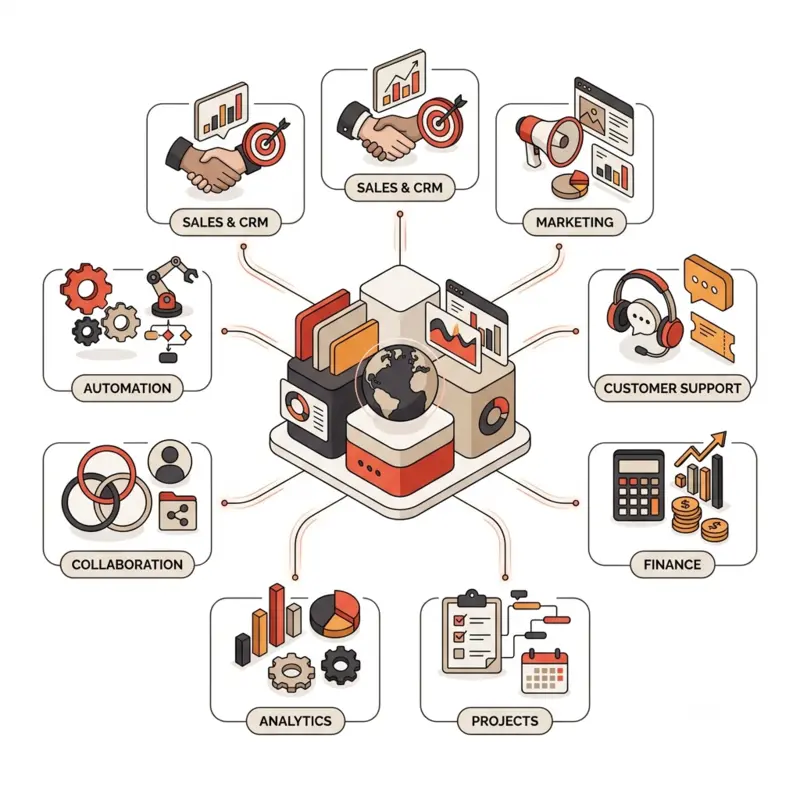
Zoho is a complete business software ecosystem that helps organizations manage CRM, sales, marketing, customer support, finance, projects, analytics, automation, and collaboration. With connected cloud applications and AI-powered capabilities, Zoho enables businesses to organize customer data, streamline workflows, automate routine tasks, and improve daily operations. Its broad range of tools supports businesses looking to build more connected and efficient digital workflows.
CRM · Business Apps · Automation · Analytics · AI
What is Zoho?
Zoho is a software company that builds and maintains a broad set of cloud applications aimed at running different parts of a business. Rather than offering one product, Zoho provides separate applications for sales, marketing, customer support, accounting, human resources, project management, analytics, and general office collaboration, each built to work on its own or alongside the others.
Because these applications are developed under one umbrella, they share design patterns and can exchange data with each other, which is one reason organizations often start with a single Zoho product commonly Zoho CRM and add further applications as additional departments need dedicated tools.
This differs from adopting a single-purpose application built by one vendor and pairing it with unrelated software from several other vendors. With Zoho, the applications are designed by the same company, which can simplify how they connect, though each still has its own setup, learning curve, and pricing.
It's worth noting that Zoho's exact position relative to other software vendors changes over time as products and markets evolve, so this guide avoids ranking claims and instead focuses on describing what the software does.
How does Zoho work?
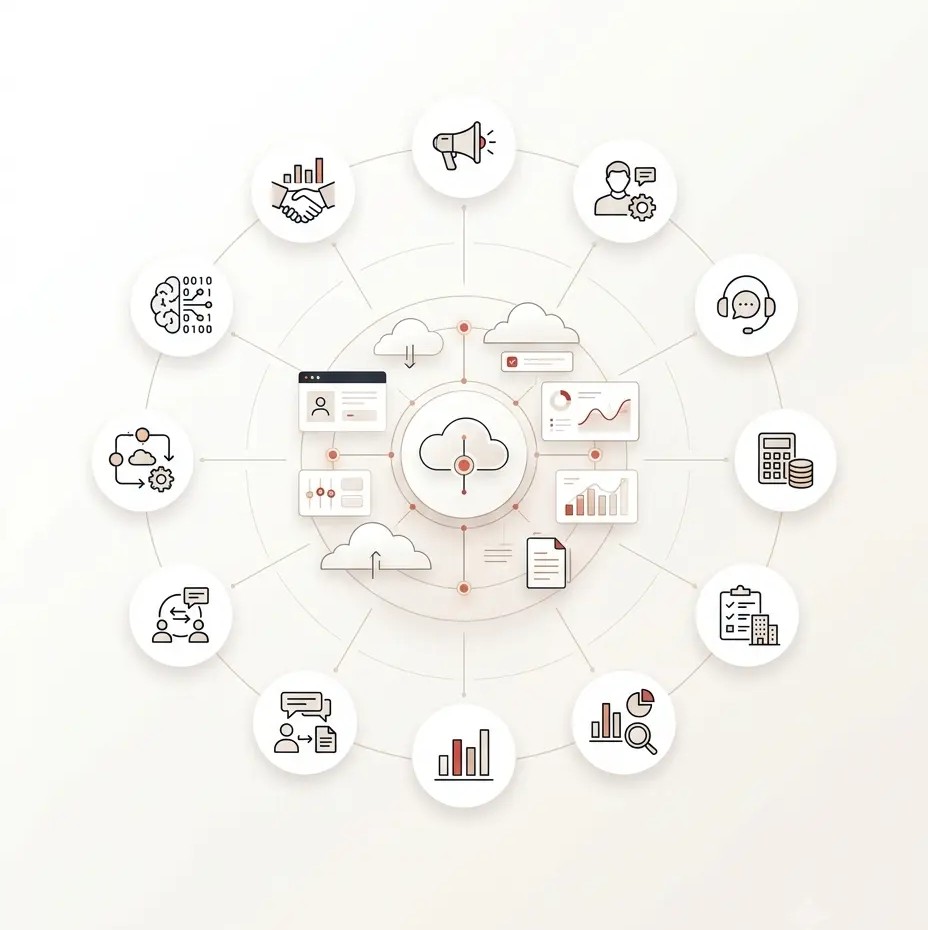
The exact setup process depends on which Zoho applications are chosen and how the organization is structured, but most implementations follow a similar sequence.
Choose the required application
Identify which Zoho product matches the immediate need — for example, Zoho CRM for sales, or Zoho Desk for support.
Configure the organization and users
Set up the company profile, user accounts, roles, and permission levels for the team that will use the application.
Import or create business data
Bring in existing records — contacts, deals, invoices, or tasks — or begin entering them directly within the application.
Customize workflows and processes
Adjust fields, layouts, and stages so the application reflects how the organization actually operates.
Connect applications and integrations
Link the application to email, accounting tools, or other software already in use, where supported.
Automate repetitive activities
Set up rules for notifications, follow-ups, approvals, and other tasks that would otherwise be handled manually.
Analyze information and improve workflows
Use built-in reports and dashboards to review performance and refine processes over time.
What is Zoho CRM?
Zoho CRM is an application built to organize customer and prospect information and to track sales activity from initial interest through to a closed deal.
At its core, Zoho CRM stores four connected types of records: leads (early-stage prospects), contacts (individual people), accounts (the companies those people belong to), and deals (specific sales opportunities). A sales pipeline arranges deals into stages, so a team can see at a glance where each opportunity stands.
Around these core records, Zoho CRM adds activities and tasks for follow-up, workflow rules that trigger actions automatically, reports and dashboards for tracking performance, and communication tools for emailing or calling contacts without leaving the application. Many editions also support customization of modules and fields, along with integrations to other software and, in certain editions, AI-assisted features through Zia.
Not every capability described here is available in every Zoho CRM edition — feature depth generally increases with higher-tier plans, so it's worth comparing editions against actual requirements rather than assuming full access by default.

How Zoho CRM works in practice
Workflows can be adjusted to fit a business's process, but a typical cycle looks like this.
Capture a lead
A prospect's details enter the system from a web form, email, event, or manual entry.
Organize customer information
Details are grouped into contacts and accounts so the full relationship history stays in one place.
Qualify prospects
Sales staff assess fit and intent before converting a lead into an active opportunity.
Move deals through the pipeline
Opportunities progress through defined stages, from initial contact to negotiation and close.
Automate repetitive tasks
Assignment rules, reminders, and follow-up emails reduce manual administrative work.
Communicate with prospects
Calls, emails, and notes are logged directly against the relevant record.
Monitor sales performance
Managers review pipeline stages, activity levels, and forecasts.
Analyze results
Reports and dashboards highlight trends so the process can be refined going forward.
Explore the Zoho ecosystem
These are among the more widely used Zoho applications. Availability of any specific application depends on the plan and edition selected.
Zoho Books
Accounting and financial management, including invoicing, expense tracking, and financial reporting.
Zoho Desk
Customer service and help desk management with ticketing and knowledge base tools.
Zoho Campaigns
Email marketing and campaign management for reaching and nurturing prospects and customers.
Zoho Analytics
Business intelligence tools for building reports, dashboards, and deeper data analysis.
Zoho Projects
Project planning, task management, and team collaboration for tracking work to completion.
Zoho SalesIQ
Website visitor engagement and live chat tools that support real-time customer interaction.
Zoho Creator
A low-code platform for building custom applications and automating specific business processes.
Zoho Workplace
A set of productivity and collaboration applications for email, documents, and team communication.
Zoho One
A bundled suite that brings together a large number of Zoho applications under a single subscription.
Zoho CRM features
Feature availability varies by edition; this list describes commonly available CRM capabilities rather than a fixed feature set for every plan.
Lead management
Capture, score, and route incoming leads to the right salesperson.
Contact management
Keep individual customer and prospect details organized in one profile.
Account management
Group related contacts under the companies or organizations they belong to.
Deal management
Track individual sales opportunities from open to closed.
Sales pipeline
Visualize where every deal stands across defined pipeline stages.
Workflow automation
Trigger actions automatically based on record changes or set conditions.
Reports & dashboards
Summarize pipeline activity, team performance, and trends visually.
Sales forecasting
Estimate expected revenue based on pipeline data and historical patterns.
Email & communication
Send and track emails and calls directly from CRM records.
Customization
Adjust modules, fields, and layouts to match business terminology and process.
CRM integrations
Connect with email providers, telephony, and other business applications.
Mobile access
Review and update records from a mobile device while away from a desk.
AI-assisted features
Selected editions include Zia-powered suggestions and data insights.
Data management
Import, deduplicate, and maintain the accuracy of CRM records over time.
Zoho's broader business capabilities
Different Zoho applications address different operational needs. Together, they cover most of the functions a growing organization typically requires.
Sales and marketing tools help teams find and nurture prospects; customer support applications handle service requests after the sale; finance applications manage invoicing and accounting; project management tools coordinate internal work; analytics applications turn raw data into usable reports; collaboration tools keep teams connected; automation reduces manual effort across all of the above; low-code tools like Zoho Creator let teams build custom internal applications; and AI capabilities through Zia are layered into select products to support day-to-day tasks.
How Zia adds AI to Zoho
Zia is Zoho's AI layer, integrated into select applications to assist with specific tasks rather than operate as a single standalone product.
- Surfacing business information and answering data-related questions
- Providing sales insights based on CRM activity and pipeline data
- Assisting with data analysis and pattern detection
- Supporting workflow suggestions and process assistance
- Helping with content-related tasks such as drafting or summarizing
- Offering predictions or recommendations where the feature is available
- Supporting general productivity tasks within connected applications
AI capabilities vary by product, edition, configuration, and regional availability. AI-assisted features are meant to support human decision-making, not replace it, and results depend on the quality and completeness of the underlying data.
Automation across Zoho applications
Automation is used throughout the Zoho ecosystem to reduce repetitive manual work, freeing up time for tasks that need human judgment.
Lead assignment
Route new leads to the right salesperson automatically based on set criteria.
Notifications
Alert relevant team members when a record changes or a deadline approaches.
Follow-up activities
Schedule reminders or emails so prospects and customers aren't missed.
Workflow rules
Trigger a defined action automatically once a specific condition is met.
Data updates
Keep related fields and records synchronized without manual edits.
Approval processes
Route requests such as discounts or expenses through defined approval steps.
Customer communication
Send scheduled or triggered messages based on customer activity.
Administrative tasks
Handle repetitive record-keeping activities that would otherwise take manual time.
Automation rules should be configured to match actual business processes; a rule that doesn't reflect how a team really works can create more friction than it removes.
Integrations & connected workflows
Zoho applications can generally connect with other software through native integrations, APIs, and marketplace extensions, letting information flow between systems instead of staying siloed.
CRM integrations
Connect Zoho CRM with telephony, chat, and other sales-related tools.
Sync with common email providers to log and send messages from within an application.
Accounting
Link sales and finance data between CRM, billing, and accounting tools.
Marketing platforms
Share contact and campaign data between marketing and sales applications.
Customer support
Connect support tickets to related CRM records for full context.
Productivity tools
Link documents, calendars, and communication tools used day to day.
APIs
Build custom connections for workflows not covered by a native integration.
Third-party applications
Extend functionality through marketplace add-ons where supported.
Exactly which integrations are available depends on the specific application, edition, region, and any technical requirements involved, so it is worth confirming compatibility with current documentation before relying on a particular connection.
Potential benefits of using Zoho
Broad application coverage
Multiple applications can address the needs of different departments under one ecosystem.
Centralized business information
Relevant data can be organized and cross-referenced within connected applications.
Workflow automation
Reduce repetitive manual processes across sales, support, and finance.
Customization
Adapt selected applications to reflect specific team workflows and terminology.
Reporting & analytics
Use built-in reports and dashboards to understand what's happening in the business.
Integration options
Connect supported applications and outside systems to keep data flowing.
Scalability
Choose products and configurations that can change as requirements evolve.
AI capabilities
Selected products provide AI-assisted features through Zia for relevant tasks.
These are potential advantages rather than guarantees — the actual benefit depends on how well the selected products match an organization's specific requirements.
Who is Zoho for?
Zoho's applications are used across a range of organization types and sizes.
Whether Zoho is a good fit depends on organization size, workflow complexity, budget, technical requirements, the specific applications needed, and how much customization those workflows require. A small team may need only one application, while a larger organization might require several connected together.
Common Zoho use cases
Sales management
Track leads, accounts, opportunities, and sales activities through Zoho CRM.
Customer support
Manage support requests and service workflows through Zoho Desk.
Marketing
Coordinate campaigns and customer engagement through Zoho Campaigns and related tools.
Finance
Manage accounting and financial processes using Zoho Books and related applications.
Project management
Organize projects, tasks, milestones, and team activities through Zoho Projects.
Business analytics
Turn business information into reports and dashboards through Zoho Analytics.
Automation
Connect repetitive processes and reduce manual administration across applications.
Customer data management
Organize customer-related information consistently across relevant applications.
Zoho vs. other CRM platforms
This table is meant to help orient a comparison, not declare an absolute winner. Feature depth, pricing, and integration options change over time for every platform listed, so treat this as a starting point for further research rather than a final answer.
| Platform | CRM | Sales Mgmt. | Marketing | Support | Automation | Analytics | AI | Customization | Best Fit |
|---|---|---|---|---|---|---|---|---|---|
| Zoho CRM | Yes | Yes | Via add-ons | Via Zoho Desk | Yes | Yes | Zia AI | Broad | Organizations wanting a connected suite of business apps |
| Salesforce | Yes | Yes | Via add-ons | Via Service Cloud | Yes | Yes | Einstein AI | Extensive | Larger teams with dedicated CRM administration |
| HubSpot | Yes | Yes | Built-in | Via Service Hub | Yes | Yes | HubSpot AI | Moderate | Marketing-led sales teams |
| Pipedrive | Yes | Yes | Limited/native | Limited | Yes | Basic-Intermediate | Sales Assistant | Moderate | Small sales-focused teams wanting simplicity |
Because capabilities, editions, and pricing change periodically for each vendor, always confirm current details directly with the provider before making a decision.
How much does Zoho cost?
Zoho pricing depends on the product, edition, number of users, billing frequency, features included, usage levels, any add-ons, contract terms, and region. Different Zoho products follow different pricing structures, so there isn't a single number that applies across the ecosystem.
Zoho CRM
Priced per user, per month, across multiple editions with increasing feature depth.
Check Current PricingZoho One
Bundled pricing that covers a large number of applications under one subscription.
Check Current PricingZoho Desk
Priced per agent, per month, across editions aimed at different support team sizes.
Check Current PricingZoho Books
Priced by organization, often based on the number of users and invoicing volume.
Check Current PricingThings to consider before choosing Zoho
Potential strengths
- Broad application ecosystem covering multiple departments
- CRM and automation capabilities in one connected platform
- Customization options across most applications
- Built-in reporting and analytics tools
- Integration possibilities with outside software
Considerations
- The large product ecosystem may take time to fully evaluate
- Feature availability varies between editions
- Advanced customization may require technical knowledge
- Integration requirements should be reviewed before implementation
- Pricing depends on the specific products and plans selected
Getting started with Zoho
Define your business requirements
Identify which processes need software support before selecting a product.
Select the relevant Zoho application
Match the requirement to the appropriate product, such as CRM, Desk, or Books.
Compare available editions
Review what each tier includes against your actual feature needs.
Configure users and permissions
Set up accounts and access levels for everyone who will use the system.
Import or create data
Bring existing records in, or begin entering new information directly.
Customize workflows
Adjust fields, stages, and rules to reflect the actual business process.
Connect required integrations
Link email, accounting, or other tools already in use.
Train users
Make sure the team understands how to use the system day to day.
Monitor reports and processes
Track how the system is performing once it's in active use.
Refine the setup over time
Adjust configuration as the organization's needs continue to change.
Frequently asked questions
What is Zoho?
Zoho is a company that builds a wide collection of cloud-based business applications, covering areas such as customer relationship management, finance, marketing, customer support, project management, and analytics. Organizations typically pick the applications that match their operational needs rather than using every product at once.
What is Zoho CRM?
Zoho CRM is a customer relationship management application used to organize leads, contacts, accounts, and deals, and to track a sales pipeline from first contact through to a closed deal. It includes workflow automation, reporting, and communication tools that support day-to-day sales activity.
How does Zoho CRM work?
In general use, a lead is captured, qualified, and converted into a contact and a deal. The deal moves through pipeline stages while automation rules handle routine tasks like assignment, reminders, and follow-up emails. Reports and dashboards then summarize pipeline health and sales activity.
Is Zoho a CRM?
Zoho is broader than a single CRM product. Zoho CRM is one application within the larger Zoho ecosystem, which also includes tools for finance, support, marketing, projects, analytics, and more.
What is Zoho One?
Zoho One is a bundled suite that brings together a large number of Zoho applications under a single subscription, intended for organizations that want access to multiple departments' tools rather than licensing each application separately.
What is Zia in Zoho?
Zia is Zoho's AI layer, built into select products to assist with tasks such as surfacing sales insights, analyzing data patterns, supporting written content, and offering predictions or recommendations. Availability and depth of these features vary by product and edition.
Is Zoho suitable for small businesses?
Many small businesses use individual Zoho applications, such as Zoho CRM or Zoho Books, because they can start with one product and add others later. Suitability still depends on budget, technical comfort, and how complex the required workflows are.
What products does Zoho offer?
Zoho offers dozens of applications across categories including CRM, finance, marketing, customer support, collaboration, project management, analytics, and low-code development. Zoho CRM, Zoho Books, Zoho Desk, Zoho Campaigns, Zoho Analytics, Zoho Projects, Zoho SalesIQ, Zoho Creator, and Zoho Workplace are among the more commonly used ones.
Can Zoho integrate with other software?
Zoho applications generally support integrations through native connectors, APIs, and marketplace extensions, allowing them to connect with email providers, accounting tools, marketing platforms, and other third-party services. Exact integration options depend on the specific application and edition.
How much does Zoho cost?
Zoho pricing depends on the product, edition, number of users, billing frequency, and any add-ons selected. Because pricing structures are updated periodically, it is best to check current pricing directly on Zoho's product pages before making a decision.
Is Zoho CRM customizable?
Zoho CRM supports customization of modules, fields, layouts, workflow rules, and in some editions, more advanced scripting or low-code extensions. The level of customization available typically increases with higher-tier editions.
Can Zoho automate business processes?
Automation is available across many Zoho applications in the form of workflow rules, approval processes, notifications, and scheduled actions. These are configured by an administrator based on the organization's specific processes.
Does Zoho provide customer support software?
Yes. Zoho Desk is built specifically for customer service and help desk management, including ticketing, knowledge bases, and support workflows, and it can be connected with Zoho CRM and other applications.
What is the difference between Zoho and Salesforce?
Both offer CRM and broader business application ecosystems, but they differ in pricing structure, the breadth of bundled non-CRM applications, customization depth, and target customer size. Reviewing current documentation for both is the most reliable way to compare them for a specific use case.
What should I consider before choosing Zoho?
Consider which applications your organization actually needs, how much customization your workflows require, integration requirements with existing tools, the technical comfort of your team, and current pricing for the relevant products and editions.
Explore Zoho and find the right tools for your workflow
Every organization's requirements are different. Use this guide as a starting point, then research the specific Zoho products relevant to your team, compare editions and features directly, and review current plans before deciding what to adopt.
Explore Zoho